 Add to Chrome
 Add to Firefox
 Add to Edge
Dr. DocBench: A Comprehensive Benchmark for Expert-Level and Difficult Document Parsing
May 31, 2026
Document parsing and recognition are fundamental capabilities for vision-language models (VLMs) and document processing systems. However, existing Optical Character Recognition (OCR) and document parsing benchmarks are increasingly limited in coverage and difficulty: many focus on common document genres or uniformly sampled pages where modern parsers already perform strongly, while offering limited annotation for expert-domain structures such as chemical formula, music notation, complex tables, and cross-page layouts. We introduce Dr. DocBench, a difficulty-aware benchmark for expert-level document parsing. Built from a large-scale multilingual book corpus, Dr. DocBench spans 52 BISAC subject domains and selects challenging documents through parser-failure-based sampling, targeting cases where multiple state-of-the-art systems struggle. It contains 4,514 annotated pages from long documents averaging around 100 pages, with 65k high-quality page- and block-level annotations for layout, reading order, hierarchical relations, and domain-specific visual contents. Evaluations of pipeline-based parsers and general-purpose VLMs show that strong performance on existing benchmarks does not transfer to our expert-level document parsing. Our analysis reveals substantial failures across subjects, content types, and structural attributes, highlighting Dr. DocBench as a comprehensive testbed for diagnosing and advancing document intelligence.

IntentionNav: A Benchmark for Intent-Driven Object Navigation from Implicit Human Instruction
May 22, 2026Existing object navigation benchmarks usually tell an embodied agent which object category to find, such as microwave or chair. Human-facing embodied AI is often asked something less direct: "I need something to warm this food" or "the room feels stuffy." The agent must infer the object that can satisfy the need, find a scene-grounded instance, and decide whether the goal has been reached. We study this setting as intent-driven object navigation and introduce IntentionNav, a diagnostic benchmark for active object search from implicit human instructions. Each episode provides a free-text intent, RGB-D observations, and pose, but withholds the target object name. IntentionNav contains 500 intents over 176 Isaac Sim scenes and 64 target categories. Each intent is rewritten in four controlled instruction styles and annotated with one of four intent modes, separating surface phrasing from semantic cue type under matched geometry. This paired design supports analysis of target inference, language robustness, neighborhood reachability, and terminal success rather than only aggregate success. We evaluated three VLMs using a fixed active-navigation agent. Models identify the intended target in 48.3 percent of episodes and enter its 2 m neighborhood in 68.7 percent, but terminate successfully in only 24.9 percent and achieve grounded 1 m success in 5.5 percent. Success is highest for event-script intents (28.7 percent) and lower for physical-state and affordance intents (19.2 percent and 18.5 percent), showing that indirect human intent remains a bottleneck for target selection, visual verification, and terminal localization in active embodied search.
Accelerating Transformer-Based Monocular SLAM via Geometric Utility Scoring
Apr 13, 2026Geometric Foundation Models (GFMs) have recently advanced monocular SLAM by providing robust, calibration-free 3D priors. However, deploying these models on dense video streams introduces significant computational redundancy. Current GFM-based SLAM systems typically rely on post hoc keyframe selection. Because of this, they must perform expensive dense geometric decoding simply to determine whether a frame contains novel geometry, resulting in late rejection and wasted computation. To mitigate this inefficiency, we propose LeanGate, a lightweight feed-forward frame-gating network. LeanGate predicts a geometric utility score to assess a frame's mapping value prior to the heavy GFM feature extraction and matching stages. As a predictive plug-and-play module, our approach bypasses over 90% of redundant frames. Evaluations on standard SLAM benchmarks demonstrate that LeanGate reduces tracking FLOPs by more than 85% and achieves a 5x end-to-end throughput speedup. Furthermore, it maintains the tracking and mapping accuracy of dense baselines. Project page: https://lean-gate.github.io/
Justified or Just Convincing? Error Verifiability as a Dimension of LLM Quality
Apr 06, 2026As LLMs are deployed in high-stakes settings, users must judge the correctness of individual responses, often relying on model-generated justifications such as reasoning chains or explanations. Yet, no standard measure exists for whether these justifications help users distinguish correct answers from incorrect ones. We formalize this idea as error verifiability and propose $v_{\text{bal}}$, a balanced metric that measures whether justifications enable raters to accurately assess answer correctness, validated against human raters who show high agreement. We find that neither common approaches, such as post-training and model scaling, nor more targeted interventions recommended improve verifiability. We introduce two methods that succeed at improving verifiability: reflect-and-rephrase (RR) for mathematical reasoning and oracle-rephrase (OR) for factual QA, both of which improve verifiability by incorporating domain-appropriate external information. Together, our results establish error verifiability as a distinct dimension of response quality that does not emerge from accuracy improvements alone and requires dedicated, domain-aware methods to address.
SpatialStack: Layered Geometry-Language Fusion for 3D VLM Spatial Reasoning
Mar 28, 2026Large vision-language models (VLMs) still struggle with reliable 3D spatial reasoning, a core capability for embodied and physical AI systems. This limitation arises from their inability to capture fine-grained 3D geometry and spatial relationships. While recent efforts have introduced multi-view geometry transformers into VLMs, they typically fuse only the deep-layer features from vision and geometry encoders, discarding rich hierarchical signals and creating a fundamental bottleneck for spatial understanding. To overcome this, we propose SpatialStack, a general hierarchical fusion framework that progressively aligns vision, geometry, and language representations across the model hierarchy. Moving beyond conventional late-stage vision-geometry fusion, SpatialStack stacks and synchronizes multi-level geometric features with the language backbone, enabling the model to capture both local geometric precision and global contextual semantics. Building upon this framework, we develop VLM-SpatialStack, a model that achieves state-of-the-art performance on multiple 3D spatial reasoning benchmarks. Extensive experiments and ablations demonstrate that our multi-level fusion strategy consistently enhances 3D understanding and generalizes robustly across diverse spatial reasoning tasks, establishing SpatialStack as an effective and extensible design paradigm for vision-language-geometry integration in next-generation multimodal physical AI systems.
Egocentric World Model for Photorealistic Hand-Object Interaction Synthesis
Mar 13, 2026To serve as a scalable data source for embodied AI, world models should act as true simulators that infer interaction dynamics strictly from user actions, rather than mere conditional video generators relying on privileged future object states. In this context, egocentric Human-Object Interaction (HOI) world models are critical for predicting physically grounded first-person rollouts. However, building such models is profoundly challenging due to rapid head motions, severe occlusions, and high-DoF hand articulations that abruptly alter contact topologies. Consequently, existing approaches often circumvent these physics challenges by resorting to conditional video generation with access to known future object trajectories. We introduce EgoHOI, an egocentric HOI world model that breaks away from this shortcut to simulate photorealistic, contact-consistent interactions from action signals alone. To ensure physical accuracy without future-state inputs, EgoHOI distills geometric and kinematic priors from 3D estimates into physics-informed embeddings. These embeddings regularize the egocentric rollouts toward physically valid dynamics. Experiments on the HOT3D dataset demonstrate consistent gains over strong baselines, and ablations validate the effectiveness of our physics-informed design.
Learning Actionable Manipulation Recovery via Counterfactual Failure Synthesis
Mar 13, 2026While recent foundation models have significantly advanced robotic manipulation, these systems still struggle to autonomously recover from execution errors. Current failure-learning paradigms rely on either costly and unsafe real-world data collection or simulator-based perturbations, which introduce a severe sim-to-real gap. Furthermore, existing visual analyzers predominantly output coarse, binary diagnoses rather than the executable, trajectory-level corrections required for actual recovery. To bridge the gap between failure diagnosis and actionable recovery, we introduce Dream2Fix, a framework that synthesizes photorealistic, counterfactual failure rollouts directly from successful real-world demonstrations. By perturbing actions within a generative world model, Dream2Fix creates paired failure-correction data without relying on simulators. To ensure the generated data is physically viable for robot learning, we implement a structured verification mechanism that strictly filters rollouts for task validity, visual coherence, and kinematic safety. This engine produces a high-fidelity dataset of over 120k paired samples. Using this dataset, we fine-tune a vision-language model to jointly predict failure types and precise recovery trajectories, mapping visual anomalies directly to corrective actions. Extensive real-world robotic experiments show our approach achieves state-of-the-art correction accuracy, improving from 19.7% to 81.3% over prior baselines, and successfully enables zero-shot closed-loop failure recovery in physical deployments.
MV-S2V: Multi-View Subject-Consistent Video Generation
Jan 27, 2026Existing Subject-to-Video Generation (S2V) methods have achieved high-fidelity and subject-consistent video generation, yet remain constrained to single-view subject references. This limitation renders the S2V task reducible to an S2I + I2V pipeline, failing to exploit the full potential of video subject control. In this work, we propose and address the challenging Multi-View S2V (MV-S2V) task, which synthesizes videos from multiple reference views to enforce 3D-level subject consistency. Regarding the scarcity of training data, we first develop a synthetic data curation pipeline to generate highly customized synthetic data, complemented by a small-scale real-world captured dataset to boost the training of MV-S2V. Another key issue lies in the potential confusion between cross-subject and cross-view references in conditional generation. To overcome this, we further introduce Temporally Shifted RoPE (TS-RoPE) to distinguish between different subjects and distinct views of the same subject in reference conditioning. Our framework achieves superior 3D subject consistency w.r.t. multi-view reference images and high-quality visual outputs, establishing a new meaningful direction for subject-driven video generation. Our project page is available at: https://szy-young.github.io/mv-s2v
ByteLoom: Weaving Geometry-Consistent Human-Object Interactions through Progressive Curriculum Learning
Dec 28, 2025Human-object interaction (HOI) video generation has garnered increasing attention due to its promising applications in digital humans, e-commerce, advertising, and robotics imitation learning. However, existing methods face two critical limitations: (1) a lack of effective mechanisms to inject multi-view information of the object into the model, leading to poor cross-view consistency, and (2) heavy reliance on fine-grained hand mesh annotations for modeling interaction occlusions. To address these challenges, we introduce ByteLoom, a Diffusion Transformer (DiT)-based framework that generates realistic HOI videos with geometrically consistent object illustration, using simplified human conditioning and 3D object inputs. We first propose an RCM-cache mechanism that leverages Relative Coordinate Maps (RCM) as a universal representation to maintain object's geometry consistency and precisely control 6-DoF object transformations in the meantime. To compensate HOI dataset scarcity and leverage existing datasets, we further design a training curriculum that enhances model capabilities in a progressive style and relaxes the demand of hand mesh. Extensive experiments demonstrate that our method faithfully preserves human identity and the object's multi-view geometry, while maintaining smooth motion and object manipulation.
CETCAM: Camera-Controllable Video Generation via Consistent and Extensible Tokenization
Dec 22, 2025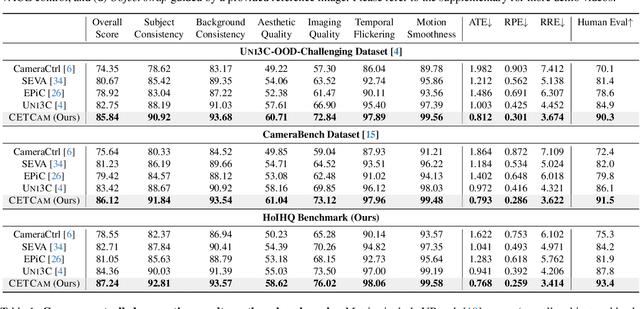

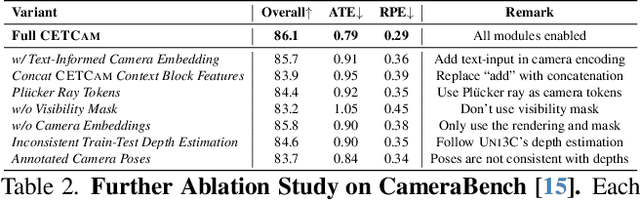
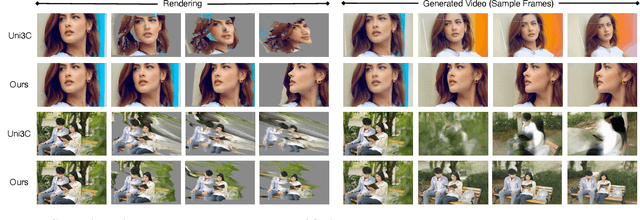
Achieving precise camera control in video generation remains challenging, as existing methods often rely on camera pose annotations that are difficult to scale to large and dynamic datasets and are frequently inconsistent with depth estimation, leading to train-test discrepancies. We introduce CETCAM, a camera-controllable video generation framework that eliminates the need for camera annotations through a consistent and extensible tokenization scheme. CETCAM leverages recent advances in geometry foundation models, such as VGGT, to estimate depth and camera parameters and converts them into unified, geometry-aware tokens. These tokens are seamlessly integrated into a pretrained video diffusion backbone via lightweight context blocks. Trained in two progressive stages, CETCAM first learns robust camera controllability from diverse raw video data and then refines fine-grained visual quality using curated high-fidelity datasets. Extensive experiments across multiple benchmarks demonstrate state-of-the-art geometric consistency, temporal stability, and visual realism. Moreover, CETCAM exhibits strong adaptability to additional control modalities, including inpainting and layout control, highlighting its flexibility beyond camera control. The project page is available at https://sjtuytc.github.io/CETCam_project_page.github.io/.